
Introduction
When choosing a projector, many users focus on resolution or brand…
But one criterion that is often overlooked is actually crucial: light output.
A projector with insufficient brightness can render an installation unusable:
- image too dark
- lack of contrast
- eye strain
Luminous flux is therefore a key factor in ensuring a comfortable and professional viewing experience.
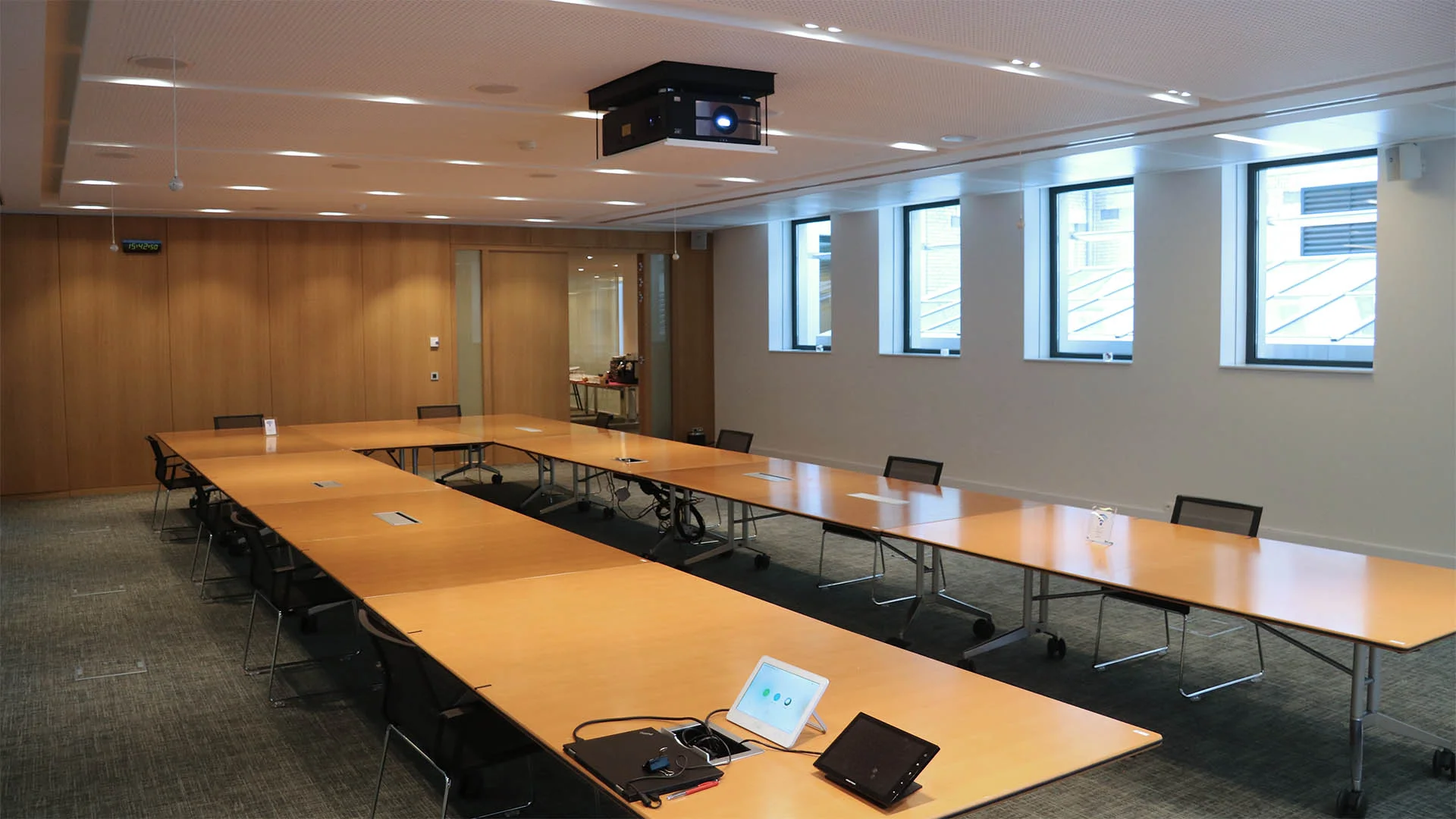
What is the light output of a projector?
The light output refers to the amount of light that the projector is capable of projecting onto the screen.
It is measured in ANSI lumens, which is the industry standard for projectors.
The higher the number of lumens:
- the brighter the image
- the longer it remains visible in a well-lit environment
Why is brightness so important?
Unlike a conventional screen, a projector is heavily dependent on its surroundings.
Poor lighting can lead to:
- a dull image
- dull colours
- a loss of clarity
Conversely, good light output allows you to:
- to maintain ambient lighting
- to improve user comfort
- to make meetings more dynamic
How do you calculate the ideal light output?
The brightness depends directly on the size of the screen.
A basic rule used in the audiovisual sector:
≈ 2200 ANSI lumens per square metre of screen
Practical example 1: 2-metre screen
- largeur : 2 m
- hauteur : 1,125 m
- surface : 2,25 m²
Puissance recommandée :
2,25 × 2200 = ± 4950 ANSI lumens
Practical example 2: 1.5-metre screen
- area: 1.28 m²
Recommended output:
1.28 × 2200 = ± 2770 ANSI lumens
Factors to consider
The theoretical calculation serves as a starting point, but several factors influence the final decision:
01. The brightness of the room
- dark room → fewer lumens required
- bright room → higher power required
02. Usage
- PowerPoint presentation → moderate brightness
- detailed video or image → higher brightness
03. Screen size
- The larger the image, the more the light is “diffused”
04. Visual comfort
The human eye perceives a brighter image as:
- more distinct
- of higher quality
Common mistakes
Under-rating the power
the most common case
Result:
- image that is difficult to read
- frustrated users
Over-engineering unnecessarily
Case study (business use)
Standard meeting room:
Recommendation:
Cela permet :
Home cinema use case
dark room:
priority:
Light output and perception of quality
A fact that is often overlooked:
- A brighter image is perceived as sharper, even if the resolution remains the same.
This means that:
- Increasing the brightness can sometimes be more effective than switching to 4K
Conclusion: how do you make the right choice?
Key points:
- base: 2200 lumens/m²
- adapt to the environment
- don’t overlook ambient light
- think about actual use before the technical specifications
AV Application’s expert opinion
Chaque installation est unique.
Chez AV Application, nous analysons :
- la pièce
- l’usage
- le type de contenu
pour proposer une solution parfaitement dimensionnée, sans surcoût inutile.
